Tuesday, November 25, 2014

Technology & Politics

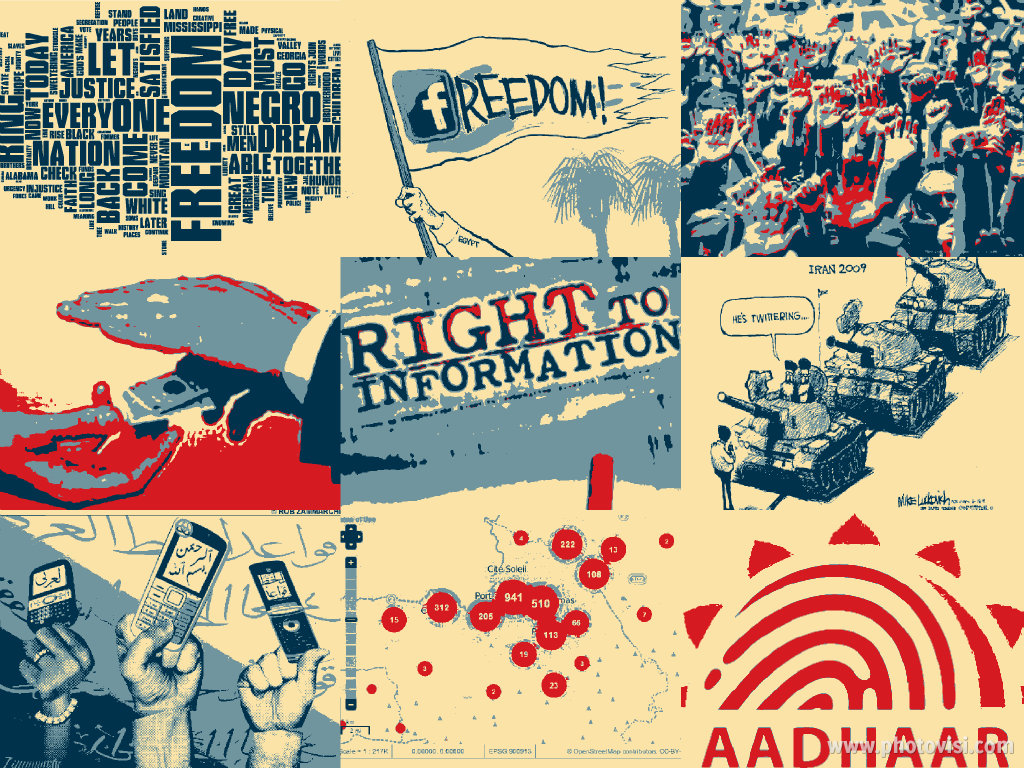
Regarding technology and politics it goes in the opposite direction as my previous posts. Technology has actually helped and improved the way we see and act on politics. When or if something happens regarding the president, it's on every website, social media, or blog post in a flash. I think in this type we can depend on technology t keep us formally updated on what happens in the government, White House, or any kind of foreign affairs. "In the past two years, we've seen the transformative impact of the internet and cellular technology. Instead of a handful of news photographers hiding to capture images at Tiananmen Square, we now see millions of people in the street, cell phones in hand, taking increasingly high quality videos and photos of state oppression... In the book George Orwell prophesized that Big Brother would watch over us. Now it looks like we get to watch over Big Brother too" (Cohen, S). Specifically the World Wide Web has been a huge help when it comes to supporting political campaigns and donations made over the Internet. Overall the internet is so convenient for everything today and it's only going to get more advanced.  "In the Obama presidential campaign here in the United States we saw another example of the transformative impact of the World Wide Web. According to Washington Post's Jose Antonio Vargas: '...3 million donors made a total of 6.5 million donations online adding up to more than $500 million. Of those 6.5 million donations, 6 million were in increments of $100 or less. The average online donation was $80, and the average Obama donor gave more than once'" (Cohen, S).  

Although the way candidates' campaign is nothing new, the internet and cell phones add a whole new level to political technology. Videos, interactive multimedia, and images are only a few of ways politicians try to use the internet to their advantage. "In addition to the images presented on the web, the internet allows people to quickly spread ideas, information and organize political protest. Information comes to the public and from the public as well" (Cohen, S). 

I think in the next couple years when it's time to vote for the next president, candidates using all types of technology will be on a roll. It's about two years from now but a lot can happen in such a small window of time. "The staggering distribution numbers, through channels like iTunes, YouTube, or podcasting websites, indicate that technology could play a critical role in the upcoming elections... Technology appeals to a specific demographic: the affluent, the educated, and the young. And while YouTube may not sway the Grandparents in the crowd, the youngest voters are listening." (Housley, S). 'Does technology have the power to change the face of politics?' I believe in the next few years technology will be a number one priority when it comes to engaging our society to go for whoever's side. "The youth in America are not currently an active voting block, but the younger generation will age, and it's only a matter of time before technology plays a critical role in elections" (Housley, S).

Resources

Cohen, S. (2009, June 23). The Impact of Technology on Political Communication. Observer.com. Retrieved November 25, 2014 from http://www.observer.com/2009/06/the-impact-of-technology-on-political-communication/

Housley, S. N.D. The Influence of Technology on Politics. Feedforall.com. Retrieved November 25, 2014 from http://www.feedforall.com/influence-of-technology.htm


Monday, November 24, 2014

Technology vs. Child

TECHNOLOGY CHILDREN
Back then I remember actually reading books as a child, playing outside on the playground and being out there until the street lights came on. My parents had to practically drag me back in the house. I remember family game nights, dinners at the table, and building forts out of the couch pillows. Today's families and children are so hooked on these devices that they are missing out on their real childhood. Kids are grabbing at their parents iPad's and iPhone's more than actual print books. "A 2010 Kaiser Foundation study showed that elementary aged children use on average 7.5 hours per day of entertainment technology, 75 percent of these children have TV's in their bedrooms, and 50 percent of North America homes have the TV on all day. Gone is dinning room table conversation, replaced by the "big screen" take out" (Rowan, C). I chose this article because it really goes into depth about how technology affects the younger generation. There wasn't really any peer review papers I could find that goes into detail as this article.  Cris Rowan, Pediatric occupational therapist,biologist, speaker and author, talks about how the children who are excessively using these devices, their developing sensory, motor and attachment skills are not developed enough to handle the fast past of today's technology. Even the fast pace advancement of technology has increased some psychological health disorders. 
2013-05-27-virtualFuturestransparent.jpg.jpg
"Child obesity and diabetes are now national epidemics in both Canada and the U.S., casually related to technology overuse. Diagnosis of ADHD, autism, coordination disorder, development delays, unintelligible speech, learning difficulties, sensory processing disorder, anxiety, depression, and sleep disorders are associated with technology overuse, and are increasing at an alarming rate" (Rowan, C). Rowan also goes into what factors are most critical to achieve healthy development in children. These consist of movement, touch, human connection, and exposure to nature. "These types of sensory inputs ensure normal development of posture, bilateral coordination, optimal arousal states and self-regulation necessary for achieving foundation skills for eventual school entry" (Rowan, C). Reminiscing back to the good ole days where I'd spend hours outside with friends or on my scooter, roller blades or just enjoying swinging on the swing. This young generation needs more time outdoors being active to achieve sensory stimulation to their proper systems and less time cooped inside on their mobile devices. Also being outside and taking in all of nature has not only a calming affect on children but is also "attention restorative and promotes learning" (Rowan, C). What the future holds may not be headed in the right direction. If we continue to allow our future children to be so tied up in technology they may not get the proper nourishment's for development and spiral into "overload".
 2013-05-27-buildingFoundationstransparent.jpg.jpg 
"Children who overuse technology report persistent body sensations of overall "shaking", increased breathing and heart rate, and a general state of unease." Its up to us and our generation to come together and help our world wake up to these technology downfalls. It affects the future generations ability to grow and learn mentally, physically and emotionally. "Rather than hugging, playing, rough housing, and conversation with children, parents are increasingly resorting to providing their children with more TV, video games, and the latest iPads and cell phone devices, creating deep and irreversible chasm between parent and child" (Roman, C).

Resources

Rowan, C. (2013, May 29). The Impact of Technology on the Developing Child. Huffingtonpost.com. Retrieved November 23, 2014 from http://www.huffingtonpost.com/cris-rowan/technology-children-negative-impact_b_3343245.html 

Wednesday, November 19, 2014

Mrs. CEO

Business leader, engineer, & computer programmer; Marissa Ann Mayer is a very powerful business woman. Born and raised in Wausau, Wisconsin, Marissa was a scholar and leader all through school. This behavior was excelled as she got older, participating in multiple extracurricular activities, volunteering and many other skills were acquired. She graduated with honors from Stanford University with a BS degree in 1997 and an MS degree in computer science in 1999 specializing in artificial intelligence. Fresh out of grad school, Marissa received 14 job offers right off the back. "Mayer's 14th job offer came from Google founders Larry Page and Sergey Brin, who quizzed her on artificial intelligence...Upon accepting an offer to lead Google's user interface and Web server teams, Mayer become the company's 20th employee and its first female engineer" (Mayer, M). 

Marrisa helped build Google working on and making recognizable products like Google Maps, Earth and Gmail. Most of her work was for the design and look of the websites, overseeing and making sure every little detail is just right. "Known as a fashionista with an eye for design, Mayer is widely credited for the unique look and feel that has come to characterize the Google experience. For example, she was responsible for approving each "doodle" appearing on the Google home page" (Mayer, M). Fast forward to about two years ago, Marissa was appointed president and CEO of Yahoo. "With Mayer as chief executive, Yahoo has been on a shopping spree. The company says it has acquired 17 companies since Mayer arrived. Among them, was the $30 million purchase of Summly..."(Marissa Mayer's top 6 accomplishments).  In her first year at Yahoo, Mayer made a big move and purchase on the famous social network blog known as Tumblr. "Mayer's biggest move in her first year came in May when Yahoo doled out $1.1 billion to buy Tumblr, a popular social network. The acquisition was a way to give Yahoo access to a younger audience"(Marissa Mayer's top 6 accomplishments).


References


Marissa Ann Mayer. (2014). The biography.com website. Retrieved November 19th, 2014 from http://www.biography.com/people/marissa-mayer-20902689.

Monday, November 17, 2014

The Pro of Technology

I recently read in the Huntington post about technology has advanced in a lot of good ways. The main purpose of technology is to make our lives easier and for it to be continuing to advance. There was an event called the Women's Forum in France which covered the influence of new technologies on our daily life in multiple sessions. One thing that I got from this article was that through technology and social media, people can be contacted in an instinct and at any time of the day. ""Social media removes all distances: geographic social, hierarchical. You can reach anyone, at any time, and communicate in real time. Thus, a permanent link of communication has been created," said Julien Maldonate, a senior manager at Deloitte" (Beliak, J).

In another session, they discussed a drawback. I analyzed how new technologies cause stress and suffering, because of the concept referred to as "Infobesity." Infobesity meaning the relentless feast of online information, typically through search engines. On of the founders and CEO's of The Social Bureau argues that the more technology is becoming more advances the more obsessed we become of wanting to control it. "People are trying to live 10 lives at once and a lot of stress and anxiety occurs from that. The two speakers even argue that we are suffering from digital bulimia, meaning that we take in a lot of information at once, without really processing it for ourselves, and in turn create a lot of new information" (Beliak, J). Said best by Christophe Aguiton, "We are at the same time creators and victims of information overload."

There are a few more benefits with technology steadily increasing. Saving money and time are two. A couple times, when I;m around, I notice my dad going on conference calls with managers and his other co-workers as well. This is one of the ways technology as been very efficient. Trying to gather everyone into the same place and time for meetings requires the time to plan ahead. "Technology limits the need for people to be in the same physical location, for example when companies hold a teleconference with several employees located in different branches or when they allow employees to telecommute from home. In some cases, this can save companies money because they do not have to pay travel expenses" (Joseph, C). Also technology can use less time to do several tasks over a period of time. "Instead of sending a message by postal mail, using email or fax can deliver it instantaneously. Technology can also speed up various manufacturing processes, as machines and computers can do work that was once performed by humans more quickly and efficiently" (Joseph, C). Technology an have  positive and negative impacts on the world, its the way we use it and how it affects us are ways that can bring change.

Beliak, J. (2013, October 21). Is Technology Making Our Lives Easier... Or Just Adding More Stress? Huffingtonpost.com. Retrieved November 16, 2014 from http://www.huffingtonpost.com/julia-beliak/womens-forum-2013_b_4138876.html

Joseph, C. N.D. Pros & Cons of Technology in Business Today. Smallbusiness.chron.com. Retrieved November 16, 2014 from http://smallbusiness.chron.com/pros-cons-technology-business-today-2709.html


Wednesday, November 12, 2014

All over the world cell phones, tablets, self-computers or iPod's seem to be all that we are on now-a-days. "According to Lee Siegel, "we shop, work, play, love, search for information, seek to communicate with each other and sometimes with the world online. We spend more time online than ever before. Yet people are not arguing about this startling new condition"” (Reynoldsburg, N). The devices we use change the way we live much faster than any contest among genes. We rely heavily on what’s the latest and greatest. Striving to get the next best thing including smarter phones, or cars when we don't really need it. Take the iPhone 6 for example, people would line up as early as 6 AM just to have the tablet of a phone.  Some people are just fine with getting the new thing that comes out while others, like myself tend to not follow the crowd. Will the improvement of technology take us in the right direction or lead the world into a downward spiral?

A man named Kevin Kelly tends to think that the improvement is a good thing. In his book "What Technology Wants," Kelly writes: "Technology wants what life wants: Increasing efficiency; Increasing opportunity; Increasing emergence; Increasing complexity; Increasing diversity; Increasing specialization; Increasing ubiquity; Increasing freedom; Increasing mutualism; Increasing beauty; Increasing sentience; Increasing structure; Increasing evolvability" (Wu, T). Not saying that all technology is bad but how we use it and rely on it may not be what’s best. According to Professor Susan Greenfield, modern technology is effecting one of our main organs. The Brain. “Human identity, the idea that defines each and every one of us, could be facing an unprecedented crisis. It is a crisis that would threaten long-held notions of who we are, what we do and how we behave. It goes right to the heart - or the head - of us all. This crisis could reshape how we interact with each other, alter what makes us happy, and modify our capacity for reaching our full potential as individuals” (Greenfield, S). Not only do these devices affect our mental state, they affect us physically as well. What I see happening in the next 25-30 years is we will know longer interact as we did before the portable inventions were surfaces, we will rely heavily on electronics and whatever the future technology may bring and also not really be our true selves.

It reminds me of the movie Wall-E how the humans had left Earth and were living on a space ship being levitated around in chairs all day, losing their figures, eating and watching TV in the same spots. They in turn can’t even walk because they were overwhelmed with new technology. We may never know what the future will bring us but our present actions can steer us down the rabbit hole. "The more advanced technology becomes, the more it seems to have control over our lives" (Reynoldsburg, N). Modern technology can radically change our lives, for the better or for worse.

References

Greenfield, S. N.D. Modern technology is changing the way our brains work, says neuroscientist. Dailymail.co.uk. Retrieved November 12, 2014 from http://www.dailymail.co.uk/sciencetech/article-565207/Modern-technology-changing-way-brains-work-says-neuroscientist.html

Reynoldsburg, N. N.D. Negative Effects of Technology on Society. Teenink.com. Retrieved November 12, 2014 from http://www.teenink.com/nonfiction/academic/article/482544/Negative-Effects-of-Technology-on-Society/

Wu, T. (2014, February 6). As Technology gets better, Will society get worse? Newyorker.com. Retrieved November 12, 2014 from http://www.newyorker.com/tech/elements/as-technology-gets-better-will-society-get-worse